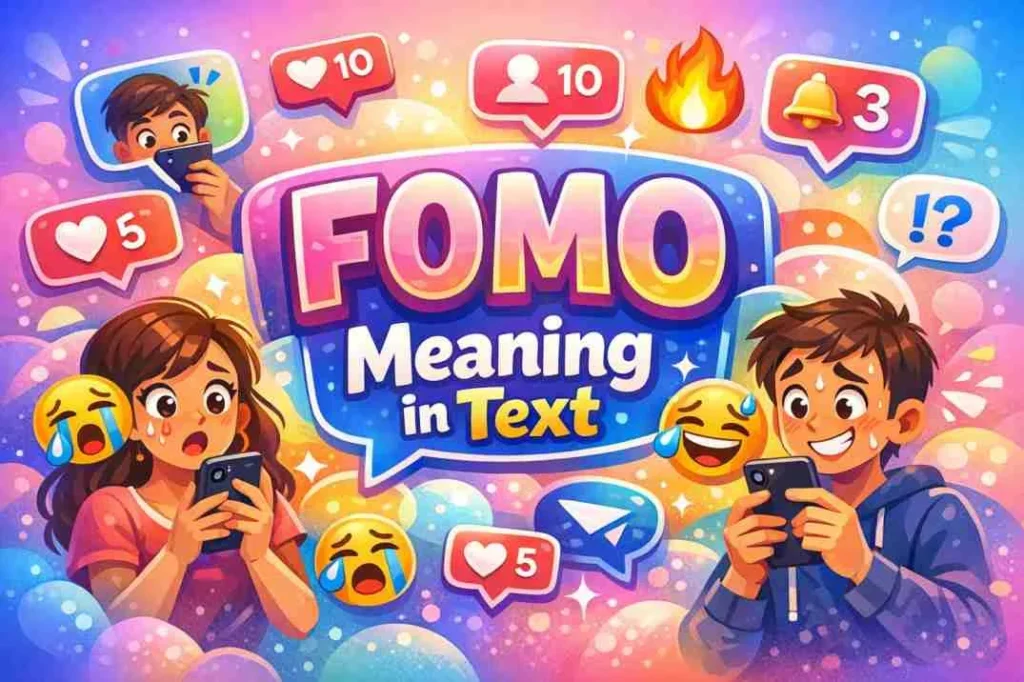

FOMO stands for “Fear of Missing Out.” It refers to the feeling of anxiety or worry that others are experiencing exciting, enjoyable, or important events without you. In texting, FOMO is often used to explain why someone wants to join in or why they feel left out.
Have you ever felt anxious scrolling through social media, seeing friends at a party, an event, or online trends you’re missing out on? That feeling has a name: FOMO. In texting and online conversations, FOMO is widely used to describe this modern-day social anxiety.
Whether it’s a party, sale, trend, or viral challenge, FOMO is part of the digital age, making it an essential term in online communication.
Origin of FOMO
The term FOMO became popular in the early 2000s as social media platforms grew. People noticed that constantly seeing posts of others’ activities could trigger anxiety or restlessness.
- 2004–2010: The rise of Facebook, Twitter, and Instagram popularized FOMO. People frequently saw events, trips, or gatherings they weren’t part of.
- Psychology Studies: Researchers began exploring FOMO as a social phenomenon, linking it to anxiety, decision-making, and social comparison.
- Modern Usage: Today, FOMO is used casually in texts, memes, and everyday conversations to describe a fear of missing opportunities, trends, or social events.
FOMO reflects both social behavior and the human desire to belong or be “in the know.”
Usage of FOMO in Texting
FOMO is often informal and used in casual texting or social media. It communicates social awareness, curiosity, or anxiety about missing out.
1. Friendly Tone
People use FOMO to express interest or eagerness to join something:
Example:
Friend 1: “We’re going to the concert tonight!”
Friend 2: “Omg, I have major FOMO! Wish I could be there 😩”
2. Neutral Tone
It can describe general social anxiety or a feeling of missing out:
Example:
“Seeing all these vacation posts gives me FOMO… maybe I need a trip too.”
3. Playful or Lighthearted Tone
FOMO can also be used jokingly:
Example:
“Everyone’s indulge-watching the new show… FOMO is real 😂”
Table: Tone, Context, and Examples
| Tone | Example Chat Text | Interpretation |
|---|---|---|
| Friendly | “I have FOMO! Can I join you guys later?” | Genuine desire to participate |
| Neutral | “FOMO is hitting me seeing everyone’s posts” | Mild anxiety or curiosity |
| Playful/Lighthearted | “FOMO is real 😂 I guess I’ll watch too” | Joking or teasing |
| Serious/Concerned | “I can’t stop checking, FOMO is real 😩” | Anxiety or social pressure |
Comparison with Related Terms
FOMO is part of a group of abbreviations or expressions that describe emotional states in text:
| Term/Abbreviation | Meaning | Tone/Usage Difference |
|---|---|---|
| FOMO | Fear of Missing Out | Social anxiety, curiosity, eagerness |
| JOMO | Joy of Missing Out | Opposite of FOMO, contentment in skipping events |
| YOLO | You Only Live Once | Encouragement to take risks or enjoy life |
| HANGRY | Hungry + Angry | Irritation from hunger, unrelated to social context |
JOMO vs FOMO:
- FOMO describes anxiety or restlessness.
- JOMO celebrates contentment in avoiding social events or trends.
YOLO vs FOMO:
- FOMO stems from missing out, often anxious.
- YOLO encourages participation, adventurous behavior, or risk-taking.
Real-World Examples of FOMO in Text
- Friendship Chats:
“Everyone’s going to the beach this weekend… FOMO is killing me 😩” - Social Media Reactions:
“Scrolling through Instagram stories gives me major FOMO 😂” - Group Messaging:
“FOMO hitting hard… why didn’t anyone invite me to the movie night?” - Shopping or Trend Context:
“Limited edition sneakers are out… FOMO is real 👟🔥” - Entertainment:
“All my friends are indulge-watching this show… FOMO is real 😭”
Polite or Professional Alternatives
In professional or polite texting, FOMO may need to be expressed differently:
- “I’d love to join if possible” – Friendly and inclusive
- “I’m interested in this opportunity” – Neutral, professional
- “Looking forward to hearing about it” – Polite and indirect
- Emojis for tone: 🙂 or 😄 can replace the anxious tone of FOMO
Table: Informal vs Professional Alternatives
| Informal (Chat) | Professional/Polite Alternative |
|---|---|
| FOMO 😩 | I’d love to join if possible |
| FOMO 😂 | Interested in participating |
| FOMO hitting me | Looking forward to updates |
| Can’t deal with FOMO | I hope to stay informed |
Cultural Context of FOMO
FOMO has become a cultural phenomenon influenced by social media, influencer culture, and online trends.
- Millennials & Gen Z: These generations experience high FOMO due to constant social connectivity.
- Marketing & Sales: Brands often leverage FOMO (“limited offer,” “last chance”) to drive engagement.
- Mental Health Awareness: FOMO is recognized as a factor in stress and anxiety management.
FOMO isn’t just slang; it reflects real human behavior shaped by the digital world.
Extended Comparison: FOMO vs Related Social Abbreviations
Here’s a more detailed table comparing FOMO, JOMO, YOLO, and HANGRY in terms of intensity, context, and emotional tone:
| Term | Intensity | Context/Usage | Tone |
|---|---|---|---|
| FOMO | Medium-High | Social media, events, trends | Anxiety, restlessness |
| JOMO | Low | Skipping events, personal downtime | Contentment, calm |
| YOLO | Medium | Adventure, risk-taking | Excitement, encouragement |
| HANGRY | Medium | Hunger-related irritation | Irritation, humor |
Key Insight: FOMO is primarily socially driven, whereas other abbreviations capture different emotional states.
Examples with Emojis
Adding emojis can enhance the meaning of FOMO:
- “FOMO 😩 I wish I could have joined the concert!”
- “Seeing everyone’s vacation posts gives me FOMO 😭”
- “FOMO hitting hard 😅 Should I check it out?”
- “Limited edition shoes… FOMO is real 👟🔥”
Emojis like 😩 😭 😅 🔥 amplify the sense of urgency, anxiety, or excitement.
FAQs
1. What does FOMO mean in texting?
FOMO stands for “Fear of Missing Out,” describing anxiety about missing events, trends, or experiences.
2. Is FOMO a negative feeling?
It can be, as it often creates restlessness or anxiety, but it can also motivate participation or engagement.
3. Can FOMO be used professionally?
In casual professional chats, yes, but rephrase for politeness: “I’d like to participate” or “Looking forward to this opportunity.”
4. How is FOMO different from YOLO?
FOMO is anxiety-driven, worrying about missing out. YOLO encourages taking action and enjoying life.
5. Is FOMO only related to social media?
No, but social media amplifies it. FOMO can appear in social, shopping, work, or entertainment contexts.
6. Can FOMO be playful in texting?
Yes, often paired with 😂 or 😅 to indicate lighthearted worry or playful longing.
7. What’s the opposite of FOMO?
JOMO – “Joy of Missing Out,” expressing contentment in skipping events or trends.
8. How can I reduce FOMO?
Limit social media exposure, practice mindfulness, and focus on your personal goals and enjoyment.
Practical Tips for Using FOMO in Text
- Use FOMO casually, not in highly formal or professional contexts.
- Combine with emojis for emphasis and tone.
- Be aware of the tone: playful, anxious, or lighthearted.
- In marketing, FOMO can be leveraged to encourage participation or sales.
- Avoid overusing it as repeated FOMO posts may seem dramatic.
Conclusion
FOMO is more than an abbreviation—it’s a digital-age phenomenon. It communicates social anxiety, curiosity, or excitement in casual texting and social media. From friendship chats to group texts and viral trends, FOMO captures a universal feeling of missing out, making conversations relatable and playful.
For professional or polite communication, use alternatives like “I’d love to join” or emojis to maintain tone. Understanding FOMO’s context and emotional nuance helps improve communication, social awareness, and even marketing strategies.
Recognizing FOMO also encourages mindfulness, helping people enjoy experiences without the constant pressure of comparison.
Read More Related Articles:
- Chris Tomlin Net Worth: Income, Wealth & Success In 2026
- AJ McLean Net Worth: Income, Wealth & Career Earnings In 2026
- Scott Patterson Net Worth: Income, Assets & Career (2025-26)