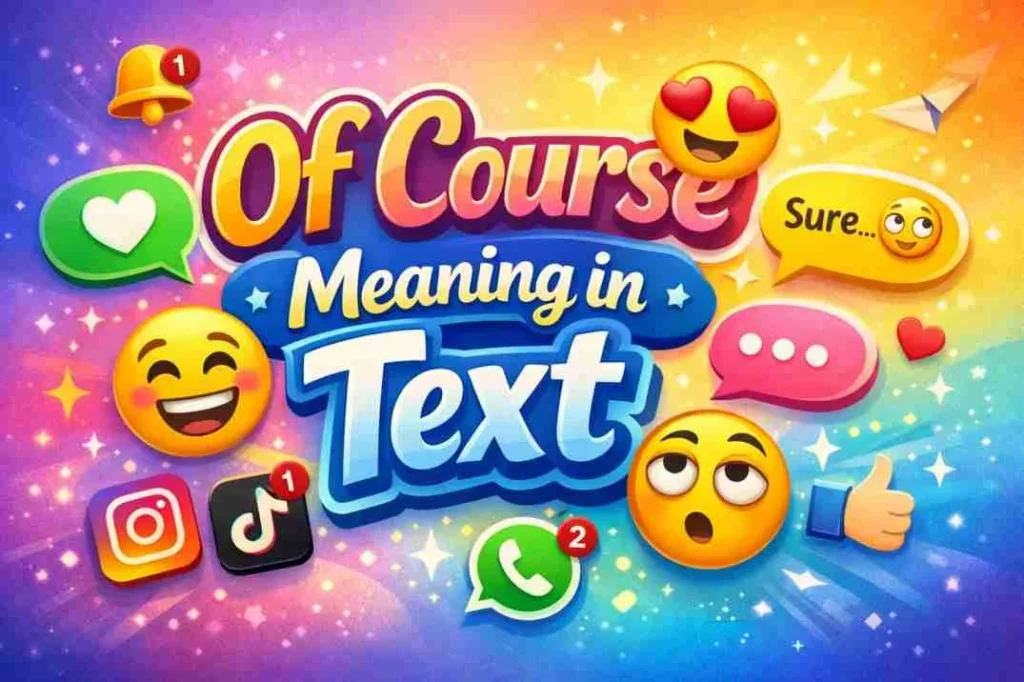

In texting and online messaging, “Of Course” is a phrase used to express agreement, affirmation, willingness, or reassurance. It signals that something is obvious, expected, or acceptable to the speaker. Depending on context, tone, punctuation, and emojis, it can feel friendly, casual, sarcastic, or even dismissive.
“Of Course” is a versatile expression that allows users to communicate consent, certainty, or enthusiasm without typing long explanations. Its brevity and clarity make it a staple in digital conversations worldwide.
Origin of “Of Course” in Digital Conversations
The phrase “Of Course” has been part of the English language for centuries, originally meaning “naturally” or “certainly.” Its journey into texting and online communication reflects how traditional language adapts to digital efficiency.
Historical Context:
- 17th-18th Century: Used in literature and polite conversation to express agreement or affirmation.
- Early 2000s SMS Era: Text messaging encouraged brevity, and “Of Course” became a preferred shorthand for polite affirmation.
- Social Media Era: Platforms like Twitter, Instagram, and WhatsApp amplified its use for quick responses, comments, and direct messages.
- Emoji Integration: Adding 😊, 😍, or 🙄 allowed users to convey emotion and tone alongside the words, giving digital nuance that text alone lacked.
Essentially, “Of Course” transitioned from formal speech to versatile digital shorthand that’s instantly recognizable across cultures and platforms.
Popularity and Real-World Usage
“Of Course” is widely used by teens, young adults, and professionals. Its popularity lies in its versatility and politeness, making it suitable for casual chats, friendly interactions, and professional communication.
Why It’s Popular:
- Polite and Approachable: Provides affirmation without being pushy or abrupt.
- Flexible Tone: Can be casual, enthusiastic, or even sarcastic depending on punctuation and emojis.
- Efficient Communication: Saves time in fast-paced messaging while still expressing agreement or reassurance.
Common Platforms:
| Platform | Example Context | Tone |
|---|---|---|
| Text Messaging | Replying to a favor or request | Friendly / Casual |
| WhatsApp Chat | Reassuring someone | Supportive / Polite |
| Instagram DM | Agreeing to collaborate or comment on a post | Friendly / Enthusiastic |
| TikTok Comments | Responding to questions or trends | Playful / Humorous |
| Email / Professional | Confirming availability or consent | Polite / Formal |
| Reddit / Forums | Agreeing with community opinions | Neutral / Supportive |
“Of Course” in Context: Examples
Understanding “Of Course” requires recognizing how tone, punctuation, and context alter meaning.
Friendly or Casual Tone
- “Of course 😊, I can help you move this weekend!”
- “Of course! That outfit looks amazing on you 😍”
These examples are warm and friendly, often enhanced with emojis to emphasize enthusiasm or kindness.
Neutral or Polite Tone
- “Of course, I will send you the report by tonight.”
- “Of course, your request has been noted.”
This tone is professional and courteous, suitable for workplace communication or formal contexts.
Sarcastic or Dismissive Tone
- “Of course… 🙄, because that’s exactly what I wanted.”
- “Of course, like I have nothing better to do.”
Sarcasm is conveyed through ellipses, punctuation, and emojis. Misreading this tone can lead to misunderstandings, so context is key.
Comparison With Related Phrases
“Of Course” is part of a broader set of phrases that communicate affirmation, agreement, or willingness. Here’s a detailed comparison:
| Phrase | Meaning / Implication | Tone | Example Usage |
|---|---|---|---|
| Of Course | Naturally, certainly, agreed | Friendly / Polite / Sarcastic | “Of course, I’ll help!” |
| Sure | Casual affirmation | Casual / Neutral | “Sure, I can do that.” |
| Absolutely | Strong agreement | Emphatic / Enthusiastic | “Absolutely, let’s go!” |
| No Problem | Willingness / helpfulness | Friendly / Casual | “No problem, I’ve got it covered.” |
| Definitely | Strong certainty | Confident / Neutral | “Definitely, I’ll be there on time.” |
| Yep / Yeah | Informal affirmation | Casual / Friendly | “Yep, I’m ready.” |
| Certainly | Formal affirmation | Polite / Professional | “Certainly, I will review this.” |
Key Takeaway: “Of Course” is more versatile than casual affirmatives like “Yep” or “Sure,” and can be adapted to professional or casual contexts depending on tone.
Alternate Meanings
While the primary meaning of “Of Course” is affirmation, subtle shifts occur depending on tone and punctuation:
- Polite Agreement: Neutral, respectful confirmation.
- Enthusiastic Affirmation: Shows excitement, often paired with exclamation marks and emojis.
- Sarcasm or Dismissal: Ellipses (…) or eye-roll emojis 🙄 convey irritation or irony.
- Professional Usage: Retains polite, neutral meaning; often without emojis.
Thus, “Of Course” can signal politeness, enthusiasm, or subtle sarcasm, making it highly versatile in digital communication.
Polite or Professional Alternatives
For professional environments or sensitive conversations, these alternatives maintain politeness and clarity:
| Expression | Tone | Example Usage |
|---|---|---|
| Certainly | Polite / Formal | “Certainly, I will complete this by 5 PM.” |
| I would be happy to | Friendly / Polite | “I would be happy to assist you with that.” |
| Absolutely | Confident / Enthusiastic | “Absolutely, I can handle it.” |
| Sure thing | Casual / Friendly | “Sure thing, I’ve got it covered.” |
| Of course, no problem | Friendly / Neutral | “Of course, no problem at all!” |
These phrases are ideal for email, Slack, or professional messaging.
Tone and Emoji Tips for “Of Course”
The tone of “Of Course” is highly context-dependent:
- Friendly / Casual: “Of course! 😊👍”
- Neutral / Polite: “Of course.”
- Enthusiastic / Excited: “Of course!! 😍🎉”
- Sarcastic / Rude: “Of course… 🙄”
Pro Tip: Emojis and punctuation are crucial in texting. They guide the reader on whether your message is friendly, professional, sarcastic, or enthusiastic.
“Of Course” Usage Infographic Table
Here’s a Pinterest-ready table showing practical examples, tone, emojis, and platforms:
| Platform | Context / Message Example | Tone | Suggested Emojis |
|---|---|---|---|
| Text Message | “Of course 😊, I’ll pick you up at 6.” | Friendly / Casual | 😊 👍 |
| Instagram DM | “Of course! That outfit is stunning 😍” | Friendly / Enthusiastic | 😍 🎉 |
| TikTok Comment | “Of course… 🙄, because that makes sense!” | Sarcastic / Playful | 🙄 😂 |
| WhatsApp Chat | “Of course, I’ll get it done tonight.” | Neutral / Polite | — |
| “Of course, I will review the document.” | Professional / Polite | — | |
| Reddit / Forum | “Of course, that’s exactly right.” | Neutral / Supportive | — |
| Snapchat Story | “Of course! Can’t wait to see you 😎” | Friendly / Playful | 😎 😁 |
| Workplace Chat | “Of course, I’ll handle this request.” | Polite / Professional | — |
Extended Examples and Scenarios
Here are additional realistic texting and online examples:
- Friend Request:
Friend: “Can you pick me up from the airport?”
You: “Of course 😊, I’ve got you covered!” - Social Media Compliment:
Follower: “Love your post! Can you share more tips?”
You: “Of course! I’ll post a tutorial tomorrow 😍” - Professional Task:
Colleague: “Can you review the report by EOD?”
You: “Of course, I’ll take care of it.” - Sarcasm / Humor:
Friend: “You didn’t finish your homework again?”
You: “Of course… 🙄, like I had time!” - Collaboration / Agreement:
Team Member: “Are you okay with this plan?”
You: “Of course, sounds perfect!” - Family Chat:
Parent: “Can you pick up groceries on your way home?”
You: “Of course, no problem 😊” - Friend Flattery Response:
Friend: “I love your style today!”
You: “Of course! Thanks 😍” - Request Denial Humor:
Friend: “Can you do my work for me?”
You: “Of course… not 😏”
These examples demonstrate the versatility of “Of Course” in different tones and contexts.
Comparison With “Sure” and Other Casual Affirmatives
| Phrase | Tone / Implication | Context Example |
|---|---|---|
| Of Course | Polite, versatile, can be sarcastic | “Of course, I can help you 😊” |
| Sure | Casual, simple affirmation | “Sure, I’ll do that.” |
| Absolutely | Strong, enthusiastic | “Absolutely! I’ll join the meeting.” |
| No Problem | Friendly, willing | “No problem, I’ve got it.” |
| Definitely | Confident, certain | “Definitely, I’ll attend.” |
FAQs
1. What does “Of Course” mean in texting?
It means agreement, affirmation, or willingness to do something. Tone and emojis can modify meaning.
2. Can “Of Course” be sarcastic?
Yes, using ellipses (…) or an eye-roll emoji 🙄 can make it sound sarcastic or dismissive.
3. Is “Of Course” formal or casual?
It can be both. Alone, it’s polite and neutral; with emojis or punctuation, it can be casual or playful.
4. Are there professional alternatives to “Of Course”?
Yes, phrases like “Certainly,” “I would be happy to,” or “Absolutely” are professional and polite.
5. Can “Of Course” express excitement?
Absolutely! Adding exclamation marks and emojis conveys enthusiasm.
6. Is “Of Course” commonly used on social media?
Yes, it’s widely used in Instagram DMs, TikTok comments, WhatsApp chats, and email.
7. What other phrases are similar to “Of Course”?
Similar expressions include “Sure,” “Absolutely,” “No Problem,” and “Definitely.”
8. Does tone affect the meaning of “Of Course”?
Yes, punctuation, emojis, and context dramatically influence whether it sounds friendly, sarcastic, formal, or enthusiastic.
Conclusion
“Of Course” is a versatile, polite, and expressive phrase in digital communication. Its meaning can range from friendly affirmation to sarcastic dismissal, depending on punctuation, emojis, and context.
Key Takeaways:
- “Of Course” = agreement, affirmation, or reassurance.
- Emojis and punctuation guide tone significantly.
- Professional alternatives include “Certainly,” “Absolutely,” or “I would be happy to.”
- Context determines whether it is casual, professional, playful, or sarcastic.
- Widely used across texting, social media, and professional communication.
Thoughtful use of “Of Course” can enhance digital conversations, convey warmth or professionalism, and prevent misinterpretation.
Read More Related Articles:
- Memphis Bleek Net Worth: From Jay-Z Protégé to Entrepreneur In 2025-26
- Judy Garland Net Worth: From Oz to Iconic Hollywood Legend In 2025-26
- Saroo Brierley Net Worth: You Won’t Believe His Net Worth In 2025-26