

A litter box camera is a small, purpose-built device that watches the one spot in your home you probably think about the least and yet reveals the most about your cat’s health. Unlike a general pet camera aimed at the couch or food bowl, it sits near the litter tray and captures every visit, timestamps it, and turns that raw activity into information you can actually read. For most owners, this is the difference between guessing and knowing. Cats hide illness by instinct, and the earliest signals almost always appear at the litter box: shifting frequency, strained postures, blood-tinged clumps, or a subtle drop in output that no human eye catches over a busy week. A camera changes that equation. It gives you a reliable timeline, an unbiased witness, and a nudge when something looks off. This guide covers what a litter box camera is, how it works, why it earns a spot in a modern cat household, and how to make the most of it once it is installed.
What a Litter Box Camera Actually Does
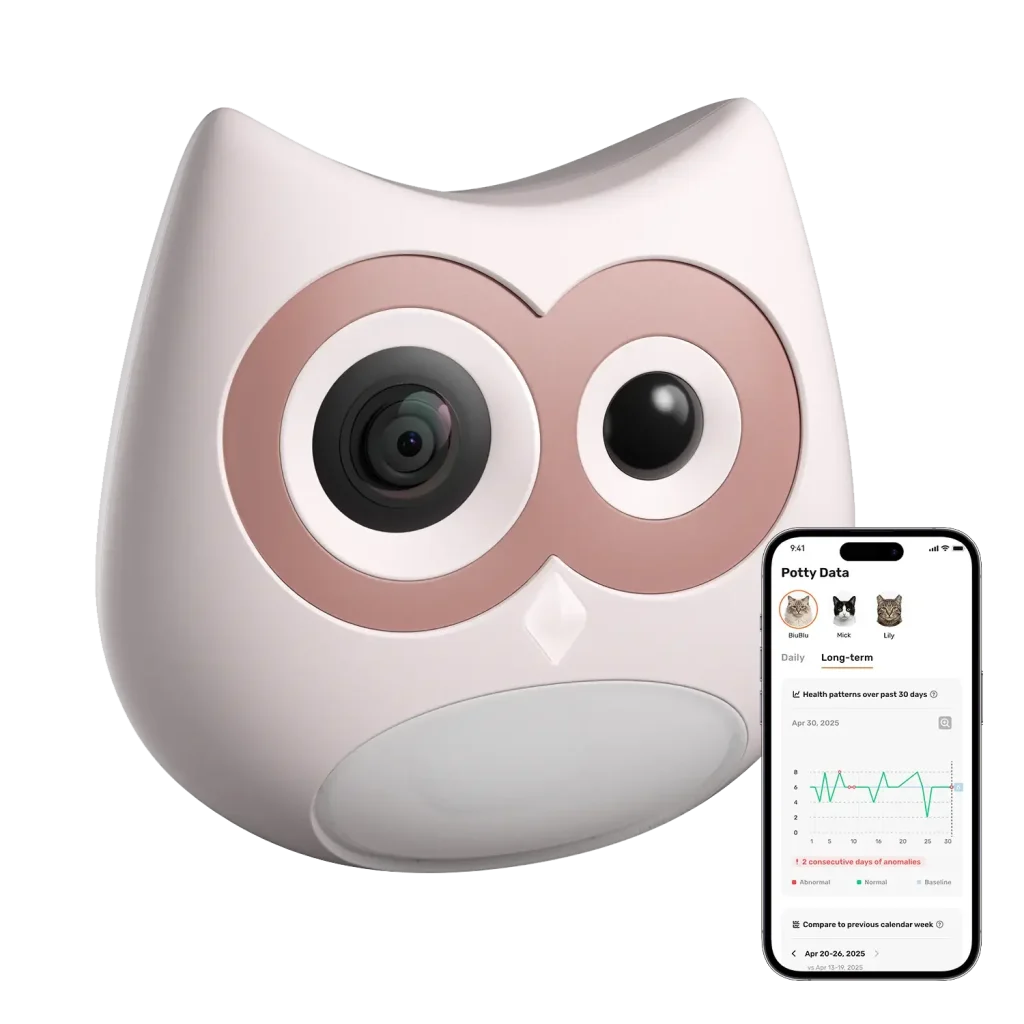
At its core, a litter box camera is a specialized monitoring tool. It records visits to the tray, notes how long each session lasts, and often distinguishes between urination and defecation based on posture, timing, and volume. Some models add weight sensors, others rely purely on vision. The best of them process what they see on-device, so raw footage of your cat in a private moment does not leave the room. What reaches your phone is a short, useful summary: which cat visited, when, for how long, and whether anything about the pattern looks unusual.
Think of it as a passive health journal that writes itself. You do not need to remember whether Milo went twice yesterday or only once. The device already knows. Over weeks, that log becomes a baseline, and once you have a baseline, anomalies become obvious. A well-designed litter box camera is not there to make you paranoid; it is there to catch the drift that human memory always misses.
Why the Litter Box Is the Right Place to Watch
Veterinarians have said for years that changes in urination and defecation are the leading early indicators of feline illness. Urinary blockages, kidney disease, diabetes, inflammatory bowel disease, and even certain cancers all leave their first traces in the tray. The problem is that owners rarely see the visit itself. Cats prefer privacy, and litter boxes are usually placed in laundry rooms, bathrooms, or corners where nobody is watching. By the time you notice something in the clumps, days may have passed.
A camera solves this by never looking away. It logs every visit, including the middle-of-the-night one you slept through and the quick, straining trip that lasted only twelve seconds. Over time, it stops being a novelty and starts being infrastructure, quiet and dependable, the same way a smoke detector is.
How Modern Devices Recognize Patterns
Older monitoring setups just streamed video and left the interpretation to you. That approach fails in practice because nobody scrubs through hours of empty footage. Current devices use computer vision trained on feline behavior to detect entries and exits, classify each event, and flag outliers. If your cat normally urinates three to four times a day and suddenly makes eight short visits, the system notices immediately. It can also learn each cat’s silhouette in multi-cat households, so alerts are per-animal instead of per-box.
The magic here is not the camera hardware, which is fairly ordinary. It is the model behind it and the discipline of only surfacing what matters. You should not need to open the app every day to feel informed. A good device stays silent until it has something worth telling you.
Catching Problems Before They Become Emergencies
Feline urinary obstruction is one of the most preventable emergencies in cats and one of the deadliest when missed. A blocked male cat can go from mildly uncomfortable to life-threatening within twenty-four hours. Owners who catch the earliest warning signs, repeated brief visits, straining without producing, restlessness near the box, buy themselves a window to see a vet before the situation turns critical.

The same principle applies to chronic conditions. A cat sliding into early-stage kidney disease will often produce more urine per visit before any lab result flags a problem. Diabetic cats drink more and pee more, and the pattern shows up in the log before the thirst becomes noticeable. Once you have data, you can walk into an appointment with something more useful than a hunch.
Multi-Cat Households and the Identification Problem
If you have more than one cat, you already know the frustration of finding a suspicious clump and having no idea who left it. Sharing a tray means shared responsibility for problems and shared blame for behaviors. A camera that identifies each cat by appearance solves this cleanly. It knows that Luna made the last visit, that Oliver is the one straining, and that the tabby who was supposed to be on a diet is going twice as often as expected.

Per-cat logs also help with introductions. When a new cat joins the family, you can see who is avoiding the box, who is guarding it, and whether territorial tension is causing anyone to hold it in. That information shapes how you place additional trays and how quickly you can settle a tense household.
Night Vision and the Always-On Requirement
Cats are crepuscular, most active at dawn and dusk, and many prefer to use the box when the house is dark and quiet. A monitoring device that only works in daylight misses half the story. Modern units include infrared night vision that captures visits without disturbing the cat or lighting up the room. Nothing about the experience changes for the animal; the tray still feels like the private space it should be.
This matters more than it sounds. Overnight visits are often the ones that carry the most diagnostic weight, because a cat that would normally sleep through eight hours suddenly making three trips is telling you something. Without night coverage, that signal is invisible.
Setup, Placement, and Living With the Device
Installation is usually straightforward: mount the unit above or beside the box, angle it toward the entry, connect to the home network, and let it observe for a few days while it learns baselines. Cats acclimate quickly because the device does not interfere with the tray itself. Owners tend to check the app heavily during the first week, then settle into a rhythm of glancing at the weekly summary and trusting the alerts. Battery-based models offer flexibility for boxes in awkward spots; wired ones give you the reassurance of never missing a charge.
Privacy considerations are worth taking seriously. Choose a device that processes footage locally when possible, encrypts anything it sends to the cloud, and lets you delete history on demand. The tray is not the living room, and the level of care applied to that data should reflect that.
Choosing a Device That Fits Your Household
Not every home needs the same device. A single-cat, healthy-adult household can get by with a simpler monitor that logs visits and flags obvious outliers. A senior cat with a chronic condition benefits from finer-grained metrics, longer history, and vet-friendly exports. Multi-cat homes need reliable per-cat identification, which is the hardest feature to get right and worth prioritizing. Look for battery life that matches your patience for charging, an app that presents data clearly, and a company that ships software updates rather than treating the hardware as finished on launch day. SiiPet designs its LitterLens hardware around exactly these priorities, and it is a reasonable reference point when comparing options in the category.

Bringing Quiet Awareness to Everyday Cat Care
Living with cats is largely an exercise in reading small signals, a paused meal, a sudden nap in a new spot, a slightly different meow, and hoping you interpret them correctly. The litter box has always been the richest source of those signals and the hardest one to monitor consistently. A dedicated camera closes that gap without asking anything of the cat and very little of you. It sits in the corner, watches, learns, and stays out of the way until it has a reason to speak. When it does speak, the message is usually early enough to matter: a shift in frequency worth mentioning at the next checkup, an overnight pattern that explains the daytime grumpiness, or an urgent flag that saves a trip to the emergency vet from turning into something worse. The value is not in the device itself but in what it lets you do, which is care with fewer blind spots. For any household that takes feline health seriously, that quiet awareness is worth the small footprint the camera occupies.

