

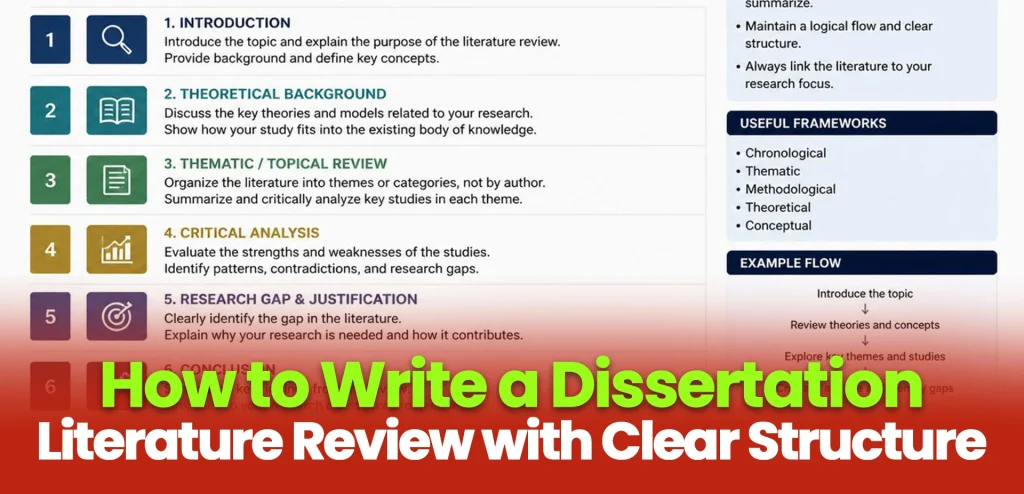
A dissertation literature review is one of the most important parts of academic research. It shows that you are aware of the existing research, theories, rationale, and research gaps in relation to your topic. The majority of students think that a literature review is simply the review of books and journal articles, which is not the case. A good literature review will provide an idea of what has already been conducted, compare the different views, critically evaluate the previous studies, and also give a clear foundation based on which your own dissertation will be conducted.
Composing a dissertation literature review in a well-defined structure aids the reader in comprehending the importance of your research. It is also a good means of showing that your work is connected with the discourse of academics and is not a work based on mere opinion. When this chapter is structured properly, it makes the relation between your introduction and methodology.
Know the Intendency of a Literature Review
Before you start writing a literature review, you must know the purpose of writing it. The chapter has not been written to discuss all the sources that you have read. Instead, it has to organise the prior knowledge in your dissertation topic. It should show that you have done your research as a continuation of some larger scholarly discussion.
A good literature review will make certain key ideas clear and elaborate on key theories, key findings, and where future studies need to be conducted. It will also help justify your research question. In case the gap is not filled in by previous studies, your dissertation can seek to fill that gap.
With the student having issues concerning the manner in which the academic research should be structured, many address help with assignments, but being aware of the concept of each of the dissertation chapters may allow a student to get a better idea of what the writing process may be like.
Find Academic Reliable Sources
A dissertation literature review must be on credible sources. These may be peer-reviewed journal articles, scholarly books, research findings, governmental, and trustworthy industry research. Blogs, general websites, and opinion-based materials should be avoided more than the others, unless this is allowed by your university for a specific reason.
Access academic databases which contain Google Scholar, university library databases, JSTOR, ScienceDirect, Emerald Insight, and SpringerLink. You can use keywords that are relevant to your dissertation topic in the search. To find helpful content, search with different combinations of words.
Recent references, especially, should also be used when your topic is in relation to any of the following: technology, business, education, healthcare, and social change. However, even the old sources may be useful, provided that they provide interesting theories or background ideas.
Theme-based Organising Sources
Once you have gathered sufficient sources, compile them into themes rather than writing about each one of them individually. Here is where the majority of the students make mistakes. A bad literature review is typically a set of summaries, and each paragraph is just a description of what the specific author said.
It is better to make comparisons of sources of the same theme. To illustrate this, rather than writing a paragraph about Author A, another about Author B, and another about Author C, you can write about how several authors concur or differ on the same issue. This demonstrates critical thinking and more insight into the subject.
When they are simply impressed by the organisation of the sources, a few of the students can resort to do my assignment support, but a simple theme-based approach can simplify the literature review.
Write a Good Introduction
There should be a proper introduction of the literature review. Here, the section should give the focus of the chapter and the general themes that will be covered. It must also put the reader in mind of how the literature review is related to your dissertation topic.
The introduction should not be too long, but it should provide guidance. You can refer to the key spheres of literature, the relevance of the topic, and the purpose of the review of the existing research. An introduction is an excellent way of giving the reader a clue about how the chapter will be organized.
Using the example of having your dissertation on digital marketing strategies, the introduction to the literature review can mention that the chapter will cover consumer behaviour, social media marketing, brand engagement, and previous studies on online buying behaviour.
Compare and Analyze previous Studies
Your literature review should also examine prior research in detail in the main body of your literature review. This implies examining what researchers discovered, how they went about their research, and whether you can use their findings in your dissertation.
It is of great importance to analyze critically. The questions to consider are: was a powerful method used in the study, was the sample size used adequate, are the results of the study still applicable, and are the study limitations.
After writing, students occasionally seek the services of edit my assignment since academic writing must be clear, flowing, and well-constructed before its final submission.
Keep a Rational Process
A good literature review should have a smooth transition between sections. Each paragraph should be connected to the preceding paragraph and should be in support of the argument. Do not jump around in ideas, authors, or theories.
Write succinct topic sentences in headings. There should be one central idea in each paragraph. Finally, in the conclusion of a section, relate the discussion to your dissertation purpose.
The structure should be changed from a general background to specific gaps in research. This will enable your chapter to be easily followed and will make the reader realize why your study is needed.
Use Proper Referencing
Referencing is very crucial in a research dissertation in a literature review. Any ideas, theories, arguments, or findings that are borrowed must be cited accordingly. Apply the referencing style that you will use at your university, e.g., Harvard, APA, MLA, or Chicago.
Referencing will help get you out of the plagiarism trap and show academic integrity. It also enables the reader to verify the sources that you used. It is better to write down all sources initially so as not to lose valuable information in the future.
Technical students who need write my IT assignment normally write on complex topics; however, in IT dissertations, academic integrity demands proper referencing and evaluation of sources.
Final Thoughts
A dissertation literature review is a transparent literature review that entails planning, research, organisation, and critical thinking. It cannot be a mere list of sources. Instead, it should be a description of the ideas of significance, a comparison of research, theories, gaps, and also relate what has been carried out in research to your own dissertation.
An effective literature review gives your dissertation academic depth and focus. Your argument has a clear structure, your research question is better, and your dissertation is more convincing. By effectively organising the sources and writing analytically, you can create a literature review that will be useful throughout the research project.

